In August I blogged about something I thought was strange: the use of Marty Haugen's tune for "Shepherd Me O God," his setting of the 23rd Psalm, as background music on multiple episodes of 48 Hours. No scandal broke as a result of my posting, but I'm following up anyway, because now I have evidence. Tonight I turned on an episode of 48 Hours: Hard Evidence (the repackaged reruns that air on Investigation Discovery) about 20 minutes in. Before long, there it was: "Shepherd Me, O God," playing completely incongruously in the background.
The episode is titled "Deep Secret." You can watch it on the CBS website. But for our purposes, just skip ahead to 41:18, and you'll hear it, played on a piano, verse and refrain. There are some embellishments, but it's unmistakably Haugen. (For comparison's sake: here's "Shepherd Me, O God.") If you watch to the end, you'll see lots of credits for outside footage, but no music credit aside from "Music composed by Richard Fiocca." (He wrote the theme music, according to his website -- which you shouldn't visit, unless you like websites that automatically play music and don't even have a mute button.)
So: what gives?
Wednesday, January 26, 2011


Saturday, December 18, 2010
Loose rei[g]ns
I've noticed typos here and there in The New Yorker over the past year or so. At first I brushed aside the conclusion that things are getting looser over there; perhaps I'm just getting better at this, I thought. (You don't turn off the error-detecting software when you're out of the office.) I try not to freak out too much about the impending Death of Print Journalism, for obvious sanity-preserving reasons. But then, in the December 13 issue, two mistakes in the same article! This is alarming. Are there any full-time copy editors and proofreaders left at Conde Nast?
The article, for those of you playing along at home, was John Lahr's profile of Elia Kazan, "Method Man." On page 91, third column, a missing close-quote:
Meanwhile, the December 20 & 27 issue is one of those double issues I spend half as much time reading. It feels like half the staff is already on vacation and the other half wishes they were. First of all, Ian Frazier is peerless and wonderful, but these lame "Cursing Mommy" pieces -- does anybody find them funny? And we also get a bonus not-funny "humor" piece, "Santaleaks" -- really? Also, am I the only one who noticed that the cartoons on page 54 and page 68 are the same joke? In both, someone is about to be executed. Page 54 caption: "His highness is changing his relationship status." Page 68 caption: "I'm about to enter an area of poor reception." (Technological phrases in incongruous settings, am I right?!) At least put them in different issues.
However, you will doubtless be pleased to know that this same issue has a feature article by our old friend John Colapinto. It is a work of breathtaking and unquestionable genius. I haven't read it. So time-saving to know I needn't bother! (P.S. If you haven't seen that old post, or it's been a while, you really ought to check it out again. The entertainment value never wanes.)
P.S. Speaking of works of genius, you can read my review of Gary Shteyngart's novel Super Sad True Love Story in the latest Commonweal -- but only if you subscribe.
The article, for those of you playing along at home, was John Lahr's profile of Elia Kazan, "Method Man." On page 91, third column, a missing close-quote:
it was Kazan, newly promoted from stage manager to actor, who shouted the play’s famous last lines—“Strike! Strike!! Strike!!!—which became the battle cry of the thirties.And on page 93, first column, the true mark of a copy editor asleep at the switch: homophone confusion!
Kazan’s straight talk cajoled, provoked, cudgelled; it kept Williams on narrative track and reigned in his lyrical excess.And I was able to copy and paste both of those from The New Yorker's website, where they still haven't been corrected. O tempora! O mores!
Meanwhile, the December 20 & 27 issue is one of those double issues I spend half as much time reading. It feels like half the staff is already on vacation and the other half wishes they were. First of all, Ian Frazier is peerless and wonderful, but these lame "Cursing Mommy" pieces -- does anybody find them funny? And we also get a bonus not-funny "humor" piece, "Santaleaks" -- really? Also, am I the only one who noticed that the cartoons on page 54 and page 68 are the same joke? In both, someone is about to be executed. Page 54 caption: "His highness is changing his relationship status." Page 68 caption: "I'm about to enter an area of poor reception." (Technological phrases in incongruous settings, am I right?!) At least put them in different issues.
However, you will doubtless be pleased to know that this same issue has a feature article by our old friend John Colapinto. It is a work of breathtaking and unquestionable genius. I haven't read it. So time-saving to know I needn't bother! (P.S. If you haven't seen that old post, or it's been a while, you really ought to check it out again. The entertainment value never wanes.)
P.S. Speaking of works of genius, you can read my review of Gary Shteyngart's novel Super Sad True Love Story in the latest Commonweal -- but only if you subscribe.
Friday, December 3, 2010
In praise of women

Circumstances conspired to give me the best possible experience, and for that I'm very grateful (I only wish I could guarantee that you would have the same circumstances align for your trip -- and you'll have to hurry, because the show is closing January 9). First of all, unlike the last time -- when I got a rear mezzanine seat and paid too much for it -- I got a half-price center orchestra seat for a Tuesday-night performance, and was delighted to find the seats in front of mine unoccupied. Talk about an unrestricted view. When I entered the lobby I checked the "At this Performance" postings, holding my breath -- any time I have a ticket to see Bernadette, I arrive half-convinced it's too good to be true and she will not be appearing that day. But there were no understudies listed for Desiree or Madame Armfeldt, and -- oh happy day -- there was an understudy listed for Anne! I had quite literally been dreading seeing Ramona Mallory again, having found her performance "actively painful" the first time around, and fate had offered me a reprieve. I practically skipped to my seat.
Saturday, November 20, 2010
It's an honor just to be nominated

One of the things I like about The Comics Curmudgeon are the cheerfully hilarious comments -- it's among the few blogs where the comments actually add value. (Although reading them can also be a chore, now that they routinely run into the hundreds on a given post.) Recognizing this, proprietor Josh began a "Comment of the Week" feature to call attention to particularly noteworthy contributions. I am proud to say I've been a runner-up a few times in the past (I boasted about one such occasion here; you can see a few examples here), but I've never taken the top honors until now. Behold, my day of glory.
Mark Trail, for those of you who don't know, is a comic strip about a park-ranger-type guy (or "well-known outdoorsman," although I believe his official profession is "nature journalist"). He goes around stumbling onto mildly nefarious plots to harm nature and busting them up, usually with his fists. The strip is the work of Jack Elrod, who is very good at drawing animals and not so great at drawing people, or writing stories or dialogue. His pursuit of the comic-strip form is pretty obviously just an excuse to draw some animals. As Josh has faithfully chronicled, Mark Trail himself seems to suffer from some kind of mental/social disorder; he speaks as though it pains him, yells for no reason, and interacts as little as possible with other human beings. Still, he has proven capable of great feats of heroism, and he knows a lot about nature, and licorice. (This recent strip is a perfect example of some of Mark Trail's most reliable tropes: bad guy kicking a helpless animal; Mark addressing the problem with his avenging fists; lots of shouting all around.) If it weren't for Josh I wouldn't even know Mark Trail existed, so this little triumph is a reminder of how very much richer my life has been these past few years. Thanks, Josh!
Wednesday, November 3, 2010
Chair situation resolved; everyone resume shopping
I know you've been dying to hear how the whole office-chair debacle turned out. Well, I'm pleased to say that I ended up being assisted by not one but two helpful people at Crate & Barrel, and after more emails back and forth they ended up having a replacement height-adjustment mechanism sent to me. It arrived this week, and it looked identical to the one I received originally (they told me they have changed the design), but I was hopeful that this one would work. So I immediately set about dismantling the chair in order to swap out the old piece for the new one.
This is where the story gets embarrassing (and probably boring, but I figure I owe you all the details).
This is where the story gets embarrassing (and probably boring, but I figure I owe you all the details).
Wednesday, October 27, 2010
Not just another "Nunsense"

Some of those in the audience the night I saw The Divine Sister might have been expecting, or hoping for, antireligion satire along the lines of Christopher Durang’s Sister Mary Ignatius Explains It All for You. But Busch’s target isn’t the church, as some have assumed. Archbishop Timothy Dolan recently cited the New York Times’s favorable coverage of The Divine Sister—“yet another tiresome production making fun of Catholic consecrated women”—as further evidence of the paper’s anti-Catholic bias. (He seemed mainly to dislike the production photos.) The weekly magazine Time Out New York is not helping by recommending the show with this blurb: “Heaven help us! Master of drag and camp Charles Busch is back and he’s making fun of nuns!” That makes The Divine Sister sound like a naughtier version of Nunsense—something the world definitely doesn’t need. In fact, the Nunsense take on religious life, as insulting as it is affectionate, is part of what Busch is spoofing. The Divine Sister parodies a specific depiction of nuns that is itself a parody of Catholicism.There's a partial indulgence in it for you if you read the whole thing.
Photo by David Rodgers.
Wednesday, October 20, 2010
Slitzweitz, Tom Bosley
I watched a couple episodes of Happy Days last night in memory of Tom Bosley. (And boy, if you want to see some strange directorial choices, season one of Happy Days is a great place to look.) But I must say I'm disappointed that his obituary in the New York Times doesn't mention the role of his that figured most prominently in my formative years: his turn as the voice of David the Gnome, bringing warmth and gravitas to what was otherwise a cheap, imported cartoon with not much to recommend it beyond the very memorable theme song. I guess it's left to me to offer that tribute. Slitzweitz, old friend.
Friday, October 15, 2010
Release the doves
Some weeks ago I was on my way to a Sunday matinee, slightly dreading the trip to Shubert Alley because I had heard about a hooray-for-Broadway concert happening in Times Square that afternoon. But I was very pleasantly surprised to discover, when I turned from Eighth Avenue onto 44th Street, that the block was closed to traffic and the crowds were behind a barrier at the other end. That meant the street itself was virtually empty, and I could walk right down the middle of it if I pleased. All around me delighted tourists were posing for pictures in the middle of the street. (Of course, tourists do that anyway, even when there's traffic headed straight for them. But these people were not risking their necks to get the shot.) I stopped to admire the facades of the theatres along that block, which I never get to do when I'm hurrying to make a show. It was marvelous. If only the pedestrian-mall revolution could be extended to the side streets, theatregoing would be a lot more fun.
At the end of the block were more police barricades, and the stage for this concert was set up just beyond them. The route I had taken, in an effort to avoid Times Square, had brought me very close to the stage -- but behind the seats, so I couldn't see it. I could certainly hear it, however, and when I got close enough I could watch the performers on huge screens. Before I was halfway down the block I recognized the voice blaring through the sound system as Marin Mazzie's -- I'd know her anywhere -- singing that "I Miss the Mountains" song from Next to Normal (which must be a hundred times better with her in it). I got near the end of the block just as she arrived at the chorus, and when she belted "IIIIIIIIIIIIIIIIIIIIIII miss the MOUN-TAINS!" the sound of it startled a whole flock of pigeons into taking to the skies right in front of me. It was a perfect kickoff to the Broadway season.
A couple of other sightings for you: sometime after that, I saw Victoria Clark crossing the street toward me, toting groceries. Doesn't that seem like something she should no longer have to do for herself, now that she is a bona fide theatre goddess? Surely she could get an adoring intern to go to the supermarket for her. I won't tell you the neighborhood, since presumably she lives nearby and that would be creepy. But I will say that, not far from there and not very long thereafter, I saw Rebecca Luker, also carring groceries. One more "diva" and we could arrange one of those awful Andrew Lloyd Webber medleys: "Love Changes Everything," anyone?
At the end of the block were more police barricades, and the stage for this concert was set up just beyond them. The route I had taken, in an effort to avoid Times Square, had brought me very close to the stage -- but behind the seats, so I couldn't see it. I could certainly hear it, however, and when I got close enough I could watch the performers on huge screens. Before I was halfway down the block I recognized the voice blaring through the sound system as Marin Mazzie's -- I'd know her anywhere -- singing that "I Miss the Mountains" song from Next to Normal (which must be a hundred times better with her in it). I got near the end of the block just as she arrived at the chorus, and when she belted "IIIIIIIIIIIIIIIIIIIIIII miss the MOUN-TAINS!" the sound of it startled a whole flock of pigeons into taking to the skies right in front of me. It was a perfect kickoff to the Broadway season.
A couple of other sightings for you: sometime after that, I saw Victoria Clark crossing the street toward me, toting groceries. Doesn't that seem like something she should no longer have to do for herself, now that she is a bona fide theatre goddess? Surely she could get an adoring intern to go to the supermarket for her. I won't tell you the neighborhood, since presumably she lives nearby and that would be creepy. But I will say that, not far from there and not very long thereafter, I saw Rebecca Luker, also carring groceries. One more "diva" and we could arrange one of those awful Andrew Lloyd Webber medleys: "Love Changes Everything," anyone?
Friday, October 8, 2010
I looked around and I noticed there wasn't a chair
Gather round, children; it's time for another dissatisfied customer story! [UPDATE: with a happy, slightly sheepish ending.]
A little more than a week ago I bought this chair from Crate & Barrel, via their website. It was delivered on Friday morning; I waited at home for the delivery guy and spent half an hour or so assembling the chair. Aside from the awkward placement of a few bolts (which forced me to screw them in using half-turns of the allen wrench), the assembly was easy. The base came with the wheels already attached, which was a relief, because the last time I bought a desk chair I had to put in the casters myself. It was a struggle. As I recall, it ultimately took a hammer -- and the assistance of my roommate's boyfriend -- to get the job done. Anyway, I got the chair all put together. The last part I attached was the height adjustment mechanism that goes on the bottom of the seat. I noticed that the piece I was holding didn't quite match the one pictured in the assembly instructions, but I didn't think it would matter. I put the seat on the base, and that's when I discovered that it did matter. The one pictured on the instruction sheet, and on the website, has a long, straight lever; the one I received has a lever bent at a 90-degree angle. If you try to pull the lever up to raise the height of the chair, it knocks into the bottom of the seat. No height adjustment. It doesn't work at all.
 Just as I was discovering this, the phone rang: it was so-and-so from Crate & Barrel, calling to find out how the delivery went! So I told her the delivery was fine, but the merchandise was not. She was really just calling to make sure the delivery guy had shown up, so she transferred me to a woman in customer service, who said, "Whaddaya mean it doesn't match?" when I described the problem with the adjustment mechanism. Then that woman transferred me to a "furniture specialist," who was much more pleasant. She put me on hold to find out whether there had been any other reported problems with the Landon chair, and she came back to report that there had not. "So the only thing we can do is switch out the chair," she said.
"You can't just send a new adjustment mechanism?" I said.
"No, we have to send a whole new chair and exchange it for that one," she said.
"So...I have to disassemble this whole thing and put it back in the box?" She assured me they don't expect it to be packaged exactly as it arrived -- which is good, because it arrived in a bunch of smaller boxes, and most of those were already torn or broken down. (The main one, currently taking up way too much room in our apartment, is pictured above.) Oh, and also: the chair was now on backorder, so I would have to wait a couple of weeks until the new one could be delivered.
A little more than a week ago I bought this chair from Crate & Barrel, via their website. It was delivered on Friday morning; I waited at home for the delivery guy and spent half an hour or so assembling the chair. Aside from the awkward placement of a few bolts (which forced me to screw them in using half-turns of the allen wrench), the assembly was easy. The base came with the wheels already attached, which was a relief, because the last time I bought a desk chair I had to put in the casters myself. It was a struggle. As I recall, it ultimately took a hammer -- and the assistance of my roommate's boyfriend -- to get the job done. Anyway, I got the chair all put together. The last part I attached was the height adjustment mechanism that goes on the bottom of the seat. I noticed that the piece I was holding didn't quite match the one pictured in the assembly instructions, but I didn't think it would matter. I put the seat on the base, and that's when I discovered that it did matter. The one pictured on the instruction sheet, and on the website, has a long, straight lever; the one I received has a lever bent at a 90-degree angle. If you try to pull the lever up to raise the height of the chair, it knocks into the bottom of the seat. No height adjustment. It doesn't work at all.
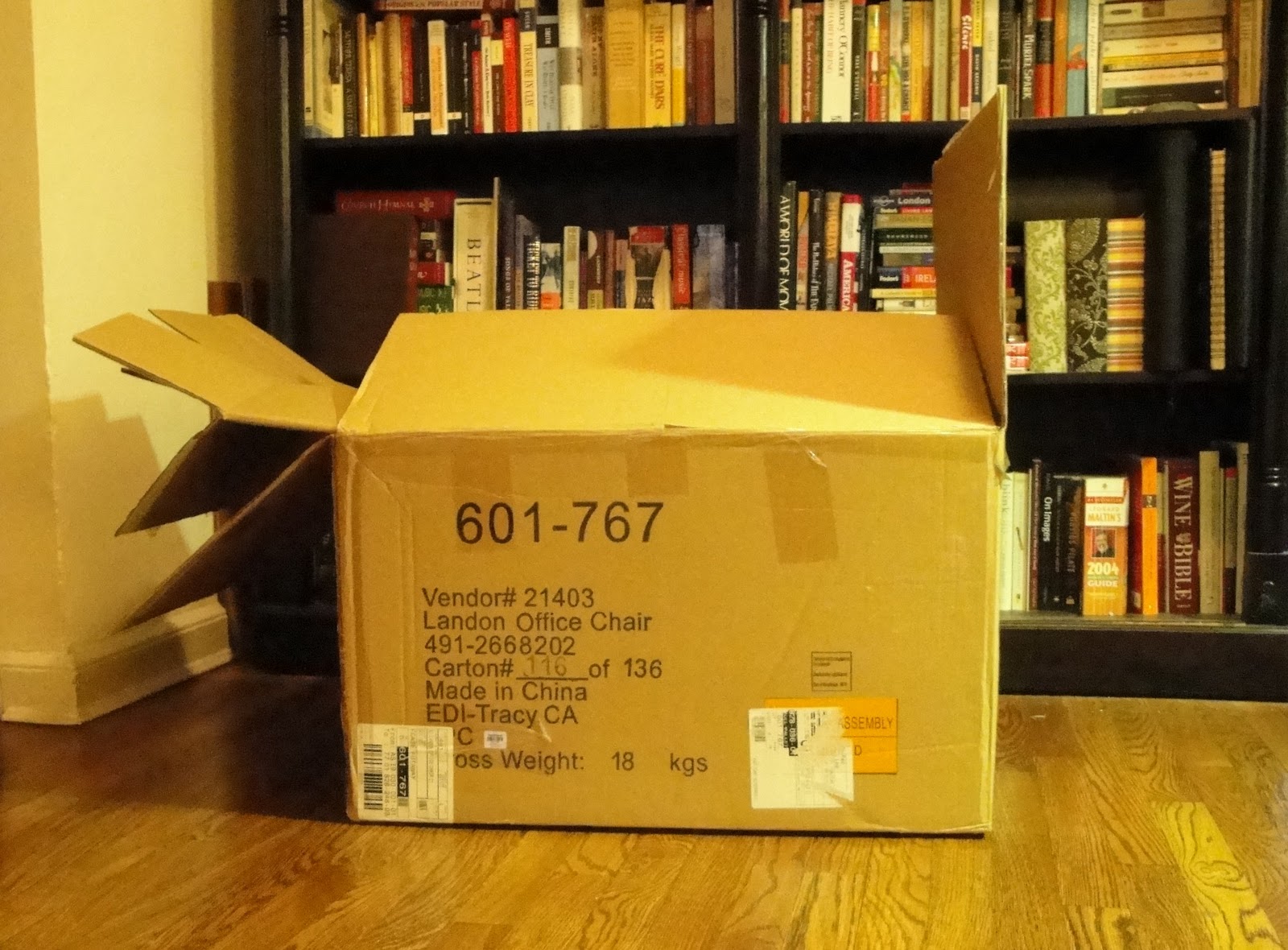
"You can't just send a new adjustment mechanism?" I said.
"No, we have to send a whole new chair and exchange it for that one," she said.
"So...I have to disassemble this whole thing and put it back in the box?" She assured me they don't expect it to be packaged exactly as it arrived -- which is good, because it arrived in a bunch of smaller boxes, and most of those were already torn or broken down. (The main one, currently taking up way too much room in our apartment, is pictured above.) Oh, and also: the chair was now on backorder, so I would have to wait a couple of weeks until the new one could be delivered.
Wednesday, October 6, 2010
I'm not quite dead...

St. Sebastian didn't die from his arrow wounds.
The funny thing is, I don't usually read the poems. But my radar went off, I guess: another knowing reference to the trappings of religion that turns out to be not-so-knowing. And as you know, when it comes to The New Yorker, no nit is too small for me to pick! I indulged my pedantic side further at dotCommonweal.
P.S. This reminds me of the not-quite-right Christmas card illustration I noted a few years ago.
UPDATE, 10/25: Marissa Bidilla has discovered another problem with Collins's poem -- or at least an earlier version of exactly the same mistake. And this time it's Tom Stoppard whose cleverness has gotten ahead of his research.
Subscribe to:
Posts (Atom)