Just wanted to let you know that I've been published on the Guardian's website. Here is my answer to the question, "Is the Catholic abuse scandal over?" based on the latest John Jay report (which is a long and dry but frequently fascinating read). Seeing my writing translated into British punctuation and spelling is the fulfillment of a dream I didn't even know I had. I believe the proper term for how I'm feeling is "chuffed."
In other what-I've-been-working-on news: I have a review of the new J. Courtney Sullivan novel, Maine, in the just-published June 3 Commonweal. Those of you discerning enough to subscribe can read it here. (Short version: I liked it.)
Showing posts with label the Catholic thing. Show all posts
Showing posts with label the Catholic thing. Show all posts
Monday, May 23, 2011


Thursday, April 21, 2011
A quick "High"
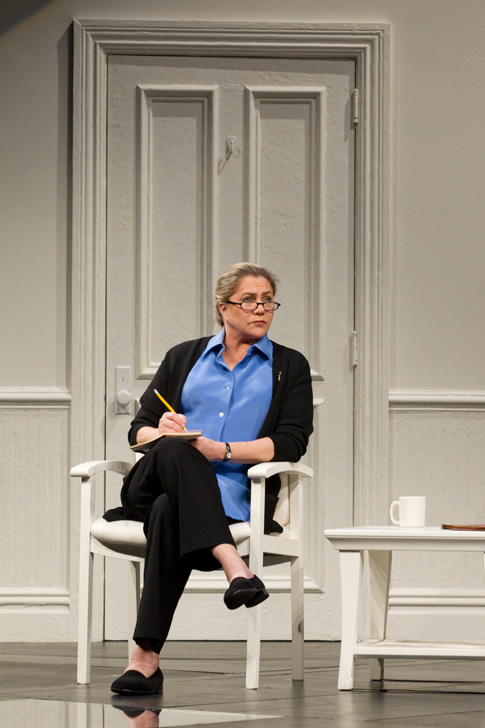
Anyway, I turned my thoughts into a blog post at dotCommonweal. Read it here, and have a very happy Holy Week!
[Photo by Joan Marcus]
Thursday, April 14, 2011
Catherine, in several convenient locations
If you subscribe to Commonweal -- and for goodness's sake, why wouldn't you? You can get 6 months' worth for just $17! -- you can read my review of Don Brophy's biography Catherine of Siena: A Passionate Life in our latest issue. St. Catherine is one of my very favorite saints and has had my back for some time now, so I was delighted to get this assignment and pleased to be able to recommend the book. It was also nice to have a chance to complain about the prayer card I picked up at her tomb in Rome, which referred to her possessing "the particular privilege of virginity and of patience" but left out some of her more notable, less passive qualities.
I mention at the beginning of the review that Catherine's head is in Siena, along with a thumb, while her body lies in Rome. Turns out my inventory wasn't quite complete, as I noted in a follow-up blog post today at dotCommonweal. (You don't have to subscribe to read that.) Looks like I need to go to Venice!
I mention at the beginning of the review that Catherine's head is in Siena, along with a thumb, while her body lies in Rome. Turns out my inventory wasn't quite complete, as I noted in a follow-up blog post today at dotCommonweal. (You don't have to subscribe to read that.) Looks like I need to go to Venice!
Wednesday, January 26, 2011
The "Shepherd Me, O God" investigation continues
In August I blogged about something I thought was strange: the use of Marty Haugen's tune for "Shepherd Me O God," his setting of the 23rd Psalm, as background music on multiple episodes of 48 Hours. No scandal broke as a result of my posting, but I'm following up anyway, because now I have evidence. Tonight I turned on an episode of 48 Hours: Hard Evidence (the repackaged reruns that air on Investigation Discovery) about 20 minutes in. Before long, there it was: "Shepherd Me, O God," playing completely incongruously in the background.
The episode is titled "Deep Secret." You can watch it on the CBS website. But for our purposes, just skip ahead to 41:18, and you'll hear it, played on a piano, verse and refrain. There are some embellishments, but it's unmistakably Haugen. (For comparison's sake: here's "Shepherd Me, O God.") If you watch to the end, you'll see lots of credits for outside footage, but no music credit aside from "Music composed by Richard Fiocca." (He wrote the theme music, according to his website -- which you shouldn't visit, unless you like websites that automatically play music and don't even have a mute button.)
So: what gives?
Wednesday, October 6, 2010
I'm not quite dead...

St. Sebastian didn't die from his arrow wounds.
The funny thing is, I don't usually read the poems. But my radar went off, I guess: another knowing reference to the trappings of religion that turns out to be not-so-knowing. And as you know, when it comes to The New Yorker, no nit is too small for me to pick! I indulged my pedantic side further at dotCommonweal.
P.S. This reminds me of the not-quite-right Christmas card illustration I noted a few years ago.
UPDATE, 10/25: Marissa Bidilla has discovered another problem with Collins's poem -- or at least an earlier version of exactly the same mistake. And this time it's Tom Stoppard whose cleverness has gotten ahead of his research.
Saturday, July 31, 2010
Slightly imperfect
I've actually been keeping up with my New Yorker reading lately (the double issues always help me catch up, since they're twice as long but half as interesting as a normal issue, and then I get a week off). Skipping the stuff I know I'll hate is helping me pick up the pace, and not stopping to blog about that or anything else has been helpful as well. But this week I blogged not once but twice at dotCommonweal about various features of the August 2 issue. First, I recommended Atul Gawande's excellent article about death and health care. And today I picked on some aggressively secularist posturing in the "Briefly Noted" section, along with a less disdainful but similarly clueless Bible reference in an earlier issue.
I'm hoping I don't need to explain what's funny about that last one to the audience over at dotComm, but for those who haven't visited a religious bookstore lately, let me clarify: the NRSV Bible is a translation, not a specific print edition. (Wikipedia puts it this way: "The New Revised Standard Version...is a thorough revision of the Revised Standard Version.") It comes in all shapes and sizes, the way Bibles do. So describing something as "about the size of the New Revised Standard Version of the Bible" (as Meghan O'Rourke does) sounds knowing and specific, but is actually very vague.
 Nox, according to Amazon.com, is 9.1 x 6 x 2.6 inches. So there are some editions of the NRSV that are about the same size. Perhaps it was this imitation leather "award Bible" O'Rourke had in mind? Or, if you wanted to get really specific, you might say it's about the size of a New King James Version Precious Moments ® Small Hands Edition Bible, available "slightly imperfect" from ChristianBook.com. I did not know it was possible to purchase a "slightly imperfect" Bible. The very idea seems slightly blasphemous―and yet, I would say a Precious Moments ® Bible is "slightly imperfect" by definition. Score one for truth in advertising.
I'm hoping I don't need to explain what's funny about that last one to the audience over at dotComm, but for those who haven't visited a religious bookstore lately, let me clarify: the NRSV Bible is a translation, not a specific print edition. (Wikipedia puts it this way: "The New Revised Standard Version...is a thorough revision of the Revised Standard Version.") It comes in all shapes and sizes, the way Bibles do. So describing something as "about the size of the New Revised Standard Version of the Bible" (as Meghan O'Rourke does) sounds knowing and specific, but is actually very vague.

Thursday, April 1, 2010
Happy Triduum!

My wonderful friend Stephen is the brains behind The Lazy Scholar, a blog that explores and exposes the Internet's many archival treasures. He was kind enough to invite me to do a guest post for Easter, and you can read the results right here. Consider it an early Easter-egg hunt.
Image: "Best Easter Wishes," Newton Owen Postcard Collection, University of Louisville Archives and Records Center, Louisville, Kentucky.
Wednesday, March 10, 2010
Songs of thankfulness and praise
I don't have time to write much -- deadlines to meet in the non-Internet-based world! -- but this is awesome, and I thought you'd want to know: a bunch of people I don't know have taken some jokes I wrote years ago and turned them into many more much funnier jokes. (More back story at dotCommonweal.) Ain't the Internet grand?
Sunday, October 11, 2009
Ora pro nobis
 The Church has five new saints today -- as of about 4:30 a.m. EST -- and one of them, Jeanne Jugan, is an old friend of the family. I wrote about how she and her Little Sisters of the Poor have been part of my family's life over at dotCommonweal. I also happened to be awake (thanks to an upset stomach) to see the canonization rite more or less as it happened. The sisters in Scranton were watching live, too!
Sunday, March 29, 2009
Oy vey
As I mentioned, I saw Irena's Vow this week. The play is based on the true story of Irene Opdyke, a Polish Catholic woman who saved the lives of several Jews during the Shoah, making it an obvious topic of interest for Commonweal! You'll have to wait for my take to appear in the magazine, but in the meantime I'd like to call your attention to the interview with Tovah Feldshuh in today's New York Times. There's a lot to love about this article, but I was especially taken with the last two paragraphs:
[Feldshuh's] only impediment with “Irena’s Vow,” she said, was trying to understand the Catholic belief in Jesus as God incarnate.Sometimes it's interesting to learn all about how actors approach their character work. And sometimes...it's better not to know.
“In my tradition,” she said, “it’s forbidden to engage in idol worship, and I wondered how I would approach Irena’s idea of Christ, and that he is the son of God. In her modesty she believed she had help, she felt surrounded by the Christ. I tend to think more along the scientific terms of a universal energy force.”
Wednesday, February 18, 2009
I'm not a theologian...
...but I play one on the radio!
I mentioned that there wasn't much "news" behind last week's New York Times story about the curious Catholic practice of seeking indulgences. Nevertheless, the topic generated enough interest that I ended up trying to explain how indulgences work on Canadian public radio! The interview I did for Commonweal made the final segment of last night's As It Happens on CBC Radio One. You can hear all six minutes on the As It Happens website: Click on "Listen to Part 3" and skip ahead to 22:47.
I mentioned that there wasn't much "news" behind last week's New York Times story about the curious Catholic practice of seeking indulgences. Nevertheless, the topic generated enough interest that I ended up trying to explain how indulgences work on Canadian public radio! The interview I did for Commonweal made the final segment of last night's As It Happens on CBC Radio One. You can hear all six minutes on the As It Happens website: Click on "Listen to Part 3" and skip ahead to 22:47.
Wednesday, February 11, 2009
Everything old is new again
I feel like I should do some outreach here. But rather than catalog the many minor inaccuracies and distortions in yesterday's front-page New York Times article about the practice of granting indulgences (it's not "absolution"; the practice never really went anywhere; this particular indulgence has been available since June, and not just locally; etc.), may I just point you to the relevant post at dotCommonweal? By coincidence, we talked about heaven, hell, purgatory, etc. in our RCIA group this week, so I've been doing a lot of research and reading on the topic. Googling has been a depressing activity since this article surfaced (and became the "most e-mailed" on the NYT site! For two days now!): so much misinformation, so many nasty remarks about those backward Catholics out there in the blogosphere. But the discussion at dotCommonweal has been lively (and mostly good-natured). Believe it or not, there are intelligent people who take this idea seriously, and some of them even have a sense of humor about it! Why not indulge your curiosity? (See what I did there?)
Tuesday, November 25, 2008
Christ, you know it ain't easy
So maybe you've heard about this whole Vatican-forgives-John-Lennon thing. That's not really what happened, of course, but it's still kind of a fun cultural thing, especially for a person like myself, whose Beatlemania is counterbalanced by a fanatical devotion to the pope. I've already spent my blogging energy hashing this out for the Catholics here and for the Beatle geeks here, so interested parties can drop in on either or both blogs for my thoughts.
Sunday, October 19, 2008
Why do men then now not reck his rod?
If you haven't yet subscribed to Commonweal, you haven't seen my review of the new(ish) novel Exiles, by Ron Hansen, which was published in the October 10 issue (and available online only to subscribers). The title of the review, "How Fiction Fails," works better when you see it in the context of the magazine -- it follows a review of James Wood's How Fiction Works. But I'm afraid it's apt, even if the joke doesn't come through. I thought I would love this one -- a novel about Gerard Manley Hopkins (one of my favorite poets) and the shipwreck that inspired his most ambitious work! Promising premise. Disappointing execution. A sample of my take:
Will this upstart critic ever like anything? Only time will tell!
Hopkins, too, is a less inspiring hero than his poems suggest, but this is due to Hansen’s reluctance to invent where the record is silent. An anxious “author’s note” declares, “Care has been taken not to contradict biographical details or historical testimony.” The result is a novel with too much fact and not enough fiction, a story told by a narrator on less-than-familiar terms with his characters. We study Hopkins from a disorientingly uncertain and limited point of view, granted access to the poet-priest’s interior life only through excerpts from his actual correspondence.Still, I enjoyed having a good reason to tackle "The Wreck of the Deutschland" again. And I am kind of excited about this forthcoming Hopkins biography...
...Late in the novel, after Hopkins’s priestly service has been all but spent in a series of inglorious assignments, Hansen allows himself, and us, to “imagine it otherwise,” outlining the life a more orthodox theologian or single-minded author might have had. It is the one true taste of fiction in an otherwise unimaginative recital of history.
Will this upstart critic ever like anything? Only time will tell!
Friday, October 3, 2008
Yes, I am still alive
I don't know what to make of the fact that traffic to this blog has been rather steady during the past week, even as actual blogging has been nonexistent. Does this mean I have reached a point where my blog is self-sustaining and can be released into the wild to fend for itself? Can it survive entirely on people searching for crossword-puzzle clues, pictures of turtles without shells, and the correct pronunciation of "Duquesne"?
Of course not. The American people -- the hockey moms and Joe Six-Packs and families sittin' around the kitchen table -- know I'm not in this for page views! At least a few of you have been coming here hoping for actual content, or maybe just wondering whether I am still alive, and I apologize for letting you down. The fact is, I just started a new job as an assistant editor at Commonweal magazine -- yes, that's right, your favorite independent, lay-published Catholic journal of opinion, religion, politics and culture! I'll be doing some writing and much editing of other, smarter people's writing, as well as a bit of blogging when I'm feeling feisty. (What do I think of the bishop of Scranton's leadership style? I'm so glad you asked.)
So, TWoPpers, that's why I'm not recapping anything this fall -- not even Private Practice, I'm sorry to say. It was a difficult decision, because recapping is fun. But the fact is, the fine art of picking apart a terrible television show is time-consuming, and I don't have that time anymore. And although I do miss my weekly date with Kate Walsh, Taye Diggs and Audra McDonald, it turns out I can't bring myself to watch the show they're on unless I'm getting paid. Oh well.
Obviously having an actual full-time job I really care about is cutting into my blogging time too. But never fear -- while it's possible this will be the last post I ever write, I'm pretty sure I'll continue posting here. At the very least, I will be shamelessly promoting my own writing when it is published elsewhere, even though much of it is likely to be available to Commonweal subscribers only. (Which means you should probably just subscribe. Try two free issues!) It's especially likely that I'll find time to blog a bit after the election is finally over, because obviously right now all of my internet time -- like yours, I assume -- is taken up with watching clips of Sarah Palin "answering" questions. If I had been blogging this past week, I probably would have just been posting one interview excerpt after another, because I have been unable to focus on much else. But it looks like we've finally seen all of the devastatingly hilarious footage, so now I can just post this highlights reel.
Also not to be missed: Slate diagrams Palin's sentences and anthologizes her poetry.
Wednesday, September 24, 2008
Check out all his majesty
The facades of Italian churches -- especially Tuscan churches -- hold all sorts of surprises. A close study of the inlaid marble images on the facade of the Cattedrale di San Martino, in Lucca, reveals the Medieval origins of one of the internet's most fearsome creatures...

Holy crap! It's Trogdor! I mean, TROG-DORRRRRR! I made sure to get my rather dashing husband in the photo so you would believe me that this totally awesome image is also totally legitimate. Now let's move in for a close-up.

This puts the "holy" in "Holy crap!" Does it not? No beefy arm, of course. And I don't see any consummate V's. So let's say it's an early prototype... But he was still TROGDOR! And that is just one more reason why Catholicism is awesome.
Monday, September 22, 2008
What do we do? We fly!
I'm back from my travels in Italy! Yesterday's nine-hour flight was pretty brutal, but we made it in one piece. Today I have lots to get done -- I start a new job tomorrow! -- and the fact that my poor body is still catching up with the clock doesn't help. (Isn't it bedtime yet?) So, fresh from the streets of Florence, I give you this "odd shot," certainly worth at least a thousand words. It's a composition I'm rather proud of, even though all I did was walk past it and pull out the camera. I think it sums up my whole Tuscany experience pretty neatly.


Monday, September 8, 2008
Obligatory joke about Explaining It All For You
In the newest issue of Commonweal: my review-slash-critical essay on Christopher Durang's The Marriage of Bette and Boo and the current -- er, make that "recent," since it closed yesterday -- Roundabout Off-Broadway revival. Looks like it's too late for a box-office bump, which is just as well, since the web version of the article is available to subscribers only.
Much of what I wrote focuses on Durang's artistic relationship with the Catholic Church. Look for a hard copy to find out more! Here's a taste of what I said about the Roundabout's production:
P.S. I didn't know my Commonweal piece would be called "Bleak House" till I saw it in print. But it's a good title, not least because it echoes one of my favorite Durang jokes, from the Woman's monologue in Laughing Wild:
Much of what I wrote focuses on Durang's artistic relationship with the Catholic Church. Look for a hard copy to find out more! Here's a taste of what I said about the Roundabout's production:
Not all the cast members seem comfortable in the play’s world. Bette’s sister Emily, played by Heather Burns, is too one-dimensional, constantly hysterical to the point of tedium. The other sister, Joan, is a grouch, but Zoe Lister-Jones makes her incongruously sarcastic where she ought to be simply bitter. And Matt’s earnest speeches tend to drag, while a few come off as wan stand-up routines. But Victoria Clark is a marvel as Margaret, straining to keep smiling through one tragedy after another, and she is nearly matched by Julie Hagerty’s giggling, heartbreaking Soot. With a subtle shift of the eyes, Christopher Evan Welch carries Boo from earnest young bridegroom to middle-aged, addlebrained drunk, surveying his failures with a haunted stare. And Kate Jennings Grant steps nimbly through Bette’s distracted monologues, gradually adding depth until her nonsensical prattling seems pitiful and real.I also said Terry Beaver was "splendid" as Father Donnally. That reminds me... I already told you about the dreadful behavior of the first audience I saw the play with. I saw it again, weeks later, with a much more attentive audience -- including an elderly priest! In his clerics! I wonder, would I have seen that in 1985?
P.S. I didn't know my Commonweal piece would be called "Bleak House" till I saw it in print. But it's a good title, not least because it echoes one of my favorite Durang jokes, from the Woman's monologue in Laughing Wild:
"My favorite book is Bleak House. Not the book, but the title. I haven't read the book. I've read the title. The title sounds the way I feel."
Wednesday, August 20, 2008
Mystery solved
To prep for an upcoming trip to Firenze, I've been dipping into Jacob Burckhardt's The Civilization of the Renaissance in Italy. (It's my favorite 19th-century book-length essay on 16th Century Europe -- what's yours?) Burckhardt has a tendency to allude to pertinent facts in the most oblique way possible, and so I am forced to visit Wikipedia to fill in the gaps in my knowledge. That's how I ended up Googling Pope Alexander VI (motto: "There's no conclusive proof that I personally poisoned anyone"), which led me to the entry for his successor, Pius III (motto: "At least I'm not Cesare Borgia!"). And that's how I got to the bottom of the summer's biggest mystery. We can all stop freaking out, because the Montauk Monster -- follow that link for a photo, on the off chance the image is not yet seared into your mind -- is not an unidentified mutant in an advanced stage of decomposition, but in fact the relatively well-preserved corpse of His Holiness Pope Pius III.


Tuesday, August 12, 2008
More views of Brideshead
If you've had a chance to read my review of the maddeningly shallow movie version of Brideshead Revisited, you've heard all about what I found wanting. But what did the other, less invested critics say? Over at the Commonweal blog (which is called -- naturally -- "dotCommonweal"), I've put together a roundup of noteworthy critical opinions. A few are insightful -- good old A.O. Scott leads the pack there. A much larger number are dismayingly misinformed, which is an object lesson in one tenet of the critic's honor code: If you haven't read the book, don't pretend you have! And, of course, there are a handful who don't seem to know there ever was a book in the first place. So fans of "critiquing the critics" should check it out. (And for extra fun, see whether you can detect the hostile attitudes toward Catholicism masquerading as commentary on the film.) I know it's not quite as fun as actually reading the novel, but it does beat seeing the movie.
Subscribe to:
Posts (Atom)