I know you've been dying to hear how the whole office-chair debacle turned out. Well, I'm pleased to say that I ended up being assisted by not one but two helpful people at Crate & Barrel, and after more emails back and forth they ended up having a replacement height-adjustment mechanism sent to me. It arrived this week, and it looked identical to the one I received originally (they told me they have changed the design), but I was hopeful that this one would work. So I immediately set about dismantling the chair in order to swap out the old piece for the new one.
This is where the story gets embarrassing (and probably boring, but I figure I owe you all the details).
Wednesday, November 3, 2010


Wednesday, October 27, 2010
Not just another "Nunsense"

Some of those in the audience the night I saw The Divine Sister might have been expecting, or hoping for, antireligion satire along the lines of Christopher Durang’s Sister Mary Ignatius Explains It All for You. But Busch’s target isn’t the church, as some have assumed. Archbishop Timothy Dolan recently cited the New York Times’s favorable coverage of The Divine Sister—“yet another tiresome production making fun of Catholic consecrated women”—as further evidence of the paper’s anti-Catholic bias. (He seemed mainly to dislike the production photos.) The weekly magazine Time Out New York is not helping by recommending the show with this blurb: “Heaven help us! Master of drag and camp Charles Busch is back and he’s making fun of nuns!” That makes The Divine Sister sound like a naughtier version of Nunsense—something the world definitely doesn’t need. In fact, the Nunsense take on religious life, as insulting as it is affectionate, is part of what Busch is spoofing. The Divine Sister parodies a specific depiction of nuns that is itself a parody of Catholicism.There's a partial indulgence in it for you if you read the whole thing.
Photo by David Rodgers.
Wednesday, October 20, 2010
Slitzweitz, Tom Bosley
I watched a couple episodes of Happy Days last night in memory of Tom Bosley. (And boy, if you want to see some strange directorial choices, season one of Happy Days is a great place to look.) But I must say I'm disappointed that his obituary in the New York Times doesn't mention the role of his that figured most prominently in my formative years: his turn as the voice of David the Gnome, bringing warmth and gravitas to what was otherwise a cheap, imported cartoon with not much to recommend it beyond the very memorable theme song. I guess it's left to me to offer that tribute. Slitzweitz, old friend.
Friday, October 15, 2010
Release the doves
Some weeks ago I was on my way to a Sunday matinee, slightly dreading the trip to Shubert Alley because I had heard about a hooray-for-Broadway concert happening in Times Square that afternoon. But I was very pleasantly surprised to discover, when I turned from Eighth Avenue onto 44th Street, that the block was closed to traffic and the crowds were behind a barrier at the other end. That meant the street itself was virtually empty, and I could walk right down the middle of it if I pleased. All around me delighted tourists were posing for pictures in the middle of the street. (Of course, tourists do that anyway, even when there's traffic headed straight for them. But these people were not risking their necks to get the shot.) I stopped to admire the facades of the theatres along that block, which I never get to do when I'm hurrying to make a show. It was marvelous. If only the pedestrian-mall revolution could be extended to the side streets, theatregoing would be a lot more fun.
At the end of the block were more police barricades, and the stage for this concert was set up just beyond them. The route I had taken, in an effort to avoid Times Square, had brought me very close to the stage -- but behind the seats, so I couldn't see it. I could certainly hear it, however, and when I got close enough I could watch the performers on huge screens. Before I was halfway down the block I recognized the voice blaring through the sound system as Marin Mazzie's -- I'd know her anywhere -- singing that "I Miss the Mountains" song from Next to Normal (which must be a hundred times better with her in it). I got near the end of the block just as she arrived at the chorus, and when she belted "IIIIIIIIIIIIIIIIIIIIIII miss the MOUN-TAINS!" the sound of it startled a whole flock of pigeons into taking to the skies right in front of me. It was a perfect kickoff to the Broadway season.
A couple of other sightings for you: sometime after that, I saw Victoria Clark crossing the street toward me, toting groceries. Doesn't that seem like something she should no longer have to do for herself, now that she is a bona fide theatre goddess? Surely she could get an adoring intern to go to the supermarket for her. I won't tell you the neighborhood, since presumably she lives nearby and that would be creepy. But I will say that, not far from there and not very long thereafter, I saw Rebecca Luker, also carring groceries. One more "diva" and we could arrange one of those awful Andrew Lloyd Webber medleys: "Love Changes Everything," anyone?
At the end of the block were more police barricades, and the stage for this concert was set up just beyond them. The route I had taken, in an effort to avoid Times Square, had brought me very close to the stage -- but behind the seats, so I couldn't see it. I could certainly hear it, however, and when I got close enough I could watch the performers on huge screens. Before I was halfway down the block I recognized the voice blaring through the sound system as Marin Mazzie's -- I'd know her anywhere -- singing that "I Miss the Mountains" song from Next to Normal (which must be a hundred times better with her in it). I got near the end of the block just as she arrived at the chorus, and when she belted "IIIIIIIIIIIIIIIIIIIIIII miss the MOUN-TAINS!" the sound of it startled a whole flock of pigeons into taking to the skies right in front of me. It was a perfect kickoff to the Broadway season.
A couple of other sightings for you: sometime after that, I saw Victoria Clark crossing the street toward me, toting groceries. Doesn't that seem like something she should no longer have to do for herself, now that she is a bona fide theatre goddess? Surely she could get an adoring intern to go to the supermarket for her. I won't tell you the neighborhood, since presumably she lives nearby and that would be creepy. But I will say that, not far from there and not very long thereafter, I saw Rebecca Luker, also carring groceries. One more "diva" and we could arrange one of those awful Andrew Lloyd Webber medleys: "Love Changes Everything," anyone?
Friday, October 8, 2010
I looked around and I noticed there wasn't a chair
Gather round, children; it's time for another dissatisfied customer story! [UPDATE: with a happy, slightly sheepish ending.]
A little more than a week ago I bought this chair from Crate & Barrel, via their website. It was delivered on Friday morning; I waited at home for the delivery guy and spent half an hour or so assembling the chair. Aside from the awkward placement of a few bolts (which forced me to screw them in using half-turns of the allen wrench), the assembly was easy. The base came with the wheels already attached, which was a relief, because the last time I bought a desk chair I had to put in the casters myself. It was a struggle. As I recall, it ultimately took a hammer -- and the assistance of my roommate's boyfriend -- to get the job done. Anyway, I got the chair all put together. The last part I attached was the height adjustment mechanism that goes on the bottom of the seat. I noticed that the piece I was holding didn't quite match the one pictured in the assembly instructions, but I didn't think it would matter. I put the seat on the base, and that's when I discovered that it did matter. The one pictured on the instruction sheet, and on the website, has a long, straight lever; the one I received has a lever bent at a 90-degree angle. If you try to pull the lever up to raise the height of the chair, it knocks into the bottom of the seat. No height adjustment. It doesn't work at all.
 Just as I was discovering this, the phone rang: it was so-and-so from Crate & Barrel, calling to find out how the delivery went! So I told her the delivery was fine, but the merchandise was not. She was really just calling to make sure the delivery guy had shown up, so she transferred me to a woman in customer service, who said, "Whaddaya mean it doesn't match?" when I described the problem with the adjustment mechanism. Then that woman transferred me to a "furniture specialist," who was much more pleasant. She put me on hold to find out whether there had been any other reported problems with the Landon chair, and she came back to report that there had not. "So the only thing we can do is switch out the chair," she said.
"You can't just send a new adjustment mechanism?" I said.
"No, we have to send a whole new chair and exchange it for that one," she said.
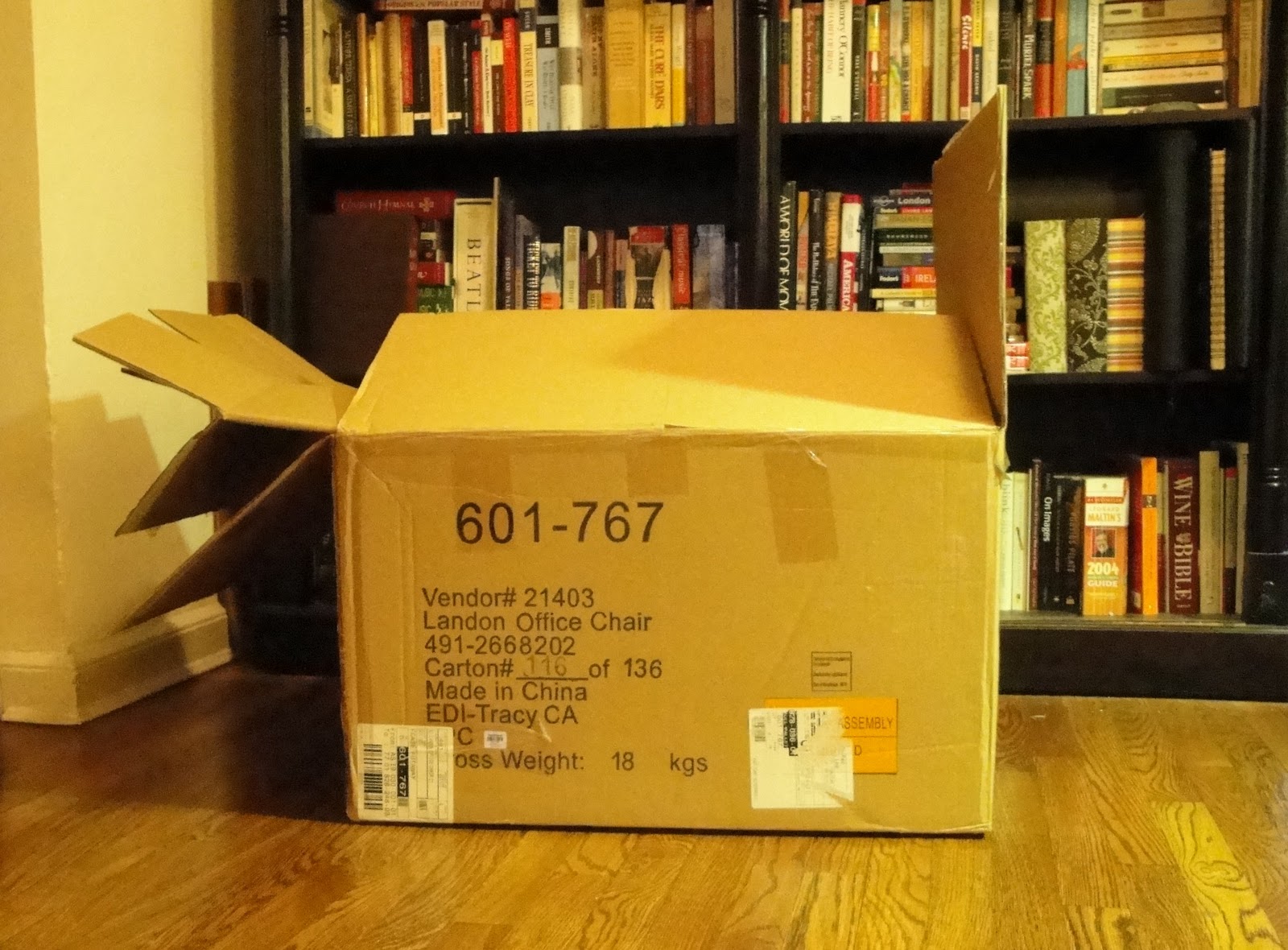
"So...I have to disassemble this whole thing and put it back in the box?" She assured me they don't expect it to be packaged exactly as it arrived -- which is good, because it arrived in a bunch of smaller boxes, and most of those were already torn or broken down. (The main one, currently taking up way too much room in our apartment, is pictured above.) Oh, and also: the chair was now on backorder, so I would have to wait a couple of weeks until the new one could be delivered.
A little more than a week ago I bought this chair from Crate & Barrel, via their website. It was delivered on Friday morning; I waited at home for the delivery guy and spent half an hour or so assembling the chair. Aside from the awkward placement of a few bolts (which forced me to screw them in using half-turns of the allen wrench), the assembly was easy. The base came with the wheels already attached, which was a relief, because the last time I bought a desk chair I had to put in the casters myself. It was a struggle. As I recall, it ultimately took a hammer -- and the assistance of my roommate's boyfriend -- to get the job done. Anyway, I got the chair all put together. The last part I attached was the height adjustment mechanism that goes on the bottom of the seat. I noticed that the piece I was holding didn't quite match the one pictured in the assembly instructions, but I didn't think it would matter. I put the seat on the base, and that's when I discovered that it did matter. The one pictured on the instruction sheet, and on the website, has a long, straight lever; the one I received has a lever bent at a 90-degree angle. If you try to pull the lever up to raise the height of the chair, it knocks into the bottom of the seat. No height adjustment. It doesn't work at all.
"You can't just send a new adjustment mechanism?" I said.
"No, we have to send a whole new chair and exchange it for that one," she said.
"So...I have to disassemble this whole thing and put it back in the box?" She assured me they don't expect it to be packaged exactly as it arrived -- which is good, because it arrived in a bunch of smaller boxes, and most of those were already torn or broken down. (The main one, currently taking up way too much room in our apartment, is pictured above.) Oh, and also: the chair was now on backorder, so I would have to wait a couple of weeks until the new one could be delivered.
Wednesday, October 6, 2010
I'm not quite dead...

St. Sebastian didn't die from his arrow wounds.
The funny thing is, I don't usually read the poems. But my radar went off, I guess: another knowing reference to the trappings of religion that turns out to be not-so-knowing. And as you know, when it comes to The New Yorker, no nit is too small for me to pick! I indulged my pedantic side further at dotCommonweal.
P.S. This reminds me of the not-quite-right Christmas card illustration I noted a few years ago.
UPDATE, 10/25: Marissa Bidilla has discovered another problem with Collins's poem -- or at least an earlier version of exactly the same mistake. And this time it's Tom Stoppard whose cleverness has gotten ahead of his research.
Friday, October 1, 2010
"Mike Barnicle, Fraud and Plagiarist"
I want to thank Tom Scocca for reassuring me that I'm not the only one who remembers that Mike Barnicle got caught plagiarizing and fabricating in his Boston Globe column, and lied about it, and was supposed to have resigned from journalism in disgrace.
I was a kid when the most blatant instance of plagiarism happened, but this was a journalism scandal I could understand. I saw Barnicle's syndicated column in my hometown newspaper now and then, so I knew how dimwitted and phoned-in it was as a matter of course. The way I saw it, there were really two facets to the scandal: first, that he'd stolen a bunch of jokes from George Carlin without giving any sort of credit; and second, that his column was regularly so pointless that a collection of apparently original Carlinesque one-liners was an unobjectionable use of the space. (The Boston Phoenix put it this way, back in 1998: "It's not so much that he copied Carlin as that he writes a lazy, second-rate column, using it to reward his friends, punish his enemies, and bore the hell out of just about everyone else.") The sort of laziness that would make someone steal to fill a waste-of-space opinion column about nothing in particular was hard for me to fathom.
And that was just one example. Barnicle had a history of plagiarism -- which I guess is not so surprising; if you hold the standards of your profession in that much contempt, what's stopping you? And of course he wasn't the only opinion columnist to ever craft a "column" entirely out of other people's ideas. But there are ways of doing it that are professionally acceptable. (Remember when Maureen Dowd got caught stealing a joke* from Talking Points Memo? Her defense was that she got it from a friend and didn't realize the friend was quoting someone else. In other words, she basically announced that she canvasses her friends for cutesy political punchlines to copy and paste into her terrible column. And that's the permissible way to fill 700 words!) Barnicle plainly did not know or care to learn how to properly credit sources. Yet even after he was exposed definitively, I kept seeing Mike Barnicle's name, or face, in major media outlets. People kept treating him like an important commentator with something to say. He's managed to edit his Wikipedia entry (I assume) so that there's no mention of plagiarism or scandal in the introduction. And now I guess he's all over this new Ken Burns documentary about baseball, which I don't plan to watch, but seriously: stop giving authority to noted liar Mike Barnicle! Or: what Tom Scocca said.
Scocca links to Salon's Joan Walsh, who points out that Barnicle's wife's connections may have something to do with his prominence in The Tenth Inning. But here's what mikebarnicle.com has to say about his involvement:
* CORRECTION: Since I'm coming down hard on other people's errors, I ought to admit my own: it wasn't a joke Dowd lifted from TPM; it was a cogent political observation. So maybe that's what she customarily gets from her "friends."
I was a kid when the most blatant instance of plagiarism happened, but this was a journalism scandal I could understand. I saw Barnicle's syndicated column in my hometown newspaper now and then, so I knew how dimwitted and phoned-in it was as a matter of course. The way I saw it, there were really two facets to the scandal: first, that he'd stolen a bunch of jokes from George Carlin without giving any sort of credit; and second, that his column was regularly so pointless that a collection of apparently original Carlinesque one-liners was an unobjectionable use of the space. (The Boston Phoenix put it this way, back in 1998: "It's not so much that he copied Carlin as that he writes a lazy, second-rate column, using it to reward his friends, punish his enemies, and bore the hell out of just about everyone else.") The sort of laziness that would make someone steal to fill a waste-of-space opinion column about nothing in particular was hard for me to fathom.
And that was just one example. Barnicle had a history of plagiarism -- which I guess is not so surprising; if you hold the standards of your profession in that much contempt, what's stopping you? And of course he wasn't the only opinion columnist to ever craft a "column" entirely out of other people's ideas. But there are ways of doing it that are professionally acceptable. (Remember when Maureen Dowd got caught stealing a joke* from Talking Points Memo? Her defense was that she got it from a friend and didn't realize the friend was quoting someone else. In other words, she basically announced that she canvasses her friends for cutesy political punchlines to copy and paste into her terrible column. And that's the permissible way to fill 700 words!) Barnicle plainly did not know or care to learn how to properly credit sources. Yet even after he was exposed definitively, I kept seeing Mike Barnicle's name, or face, in major media outlets. People kept treating him like an important commentator with something to say. He's managed to edit his Wikipedia entry (I assume) so that there's no mention of plagiarism or scandal in the introduction. And now I guess he's all over this new Ken Burns documentary about baseball, which I don't plan to watch, but seriously: stop giving authority to noted liar Mike Barnicle! Or: what Tom Scocca said.
Scocca links to Salon's Joan Walsh, who points out that Barnicle's wife's connections may have something to do with his prominence in The Tenth Inning. But here's what mikebarnicle.com has to say about his involvement:
Mark Feeney from the Boston Globe says, “Mike Barnicle, who toiled for many years at this newspaper, serves as representative of Red Sox Nation. One of his great strengths on both page and screen has always been what a potent and vivid presence he has.”That's one way to put it. Red Sox Nation must be so proud.
* CORRECTION: Since I'm coming down hard on other people's errors, I ought to admit my own: it wasn't a joke Dowd lifted from TPM; it was a cogent political observation. So maybe that's what she customarily gets from her "friends."
Saturday, September 18, 2010
Light and sweet
The first time you see In the Heights you're mostly just puzzled by the false starts and stumbles in the plot. Everyone agrees that it's formulaic, but the real problem is that it doesn't follow through on the formulas it adopts. I mean, formulas are formulas for a reason. It's sort of like watching an improv performance where the actors aren't picking up on each other's cues: you think you know where the story is going, and then it just...doesn't.
If you go back to In the Heights a second time -- at least if you're me -- you'll find yourself attempting to figure out where the plotting goes wrong, and the more you think about it the more confused you'll become. "Didn't this show have a long workshop period?" You'll think to yourself. "What in the world did they spend all that time doing, if it wasn't asking obvious questions like, 'Why can't Nina just go someplace a little more affordable than Stanford? Like, any other college?' or 'Why does the lottery win end up being almost irrelevant, when it seems like it ought to drive the whole story?'" It's maddening -- but then a really good number will come along and you'll forget all that for a while. The real dramatic tension and emotional content is all in the songs, and maybe it never goes anywhere, but it's moving just the same.
Last week I made my third visit to In the Heights -- I blogged about my first trip here at Restricted View, and I reviewed it a year later for Commonweal (when I compared it, very favorably, to the terrible Broadway revival of West Side Story). The musical, while still one of the better musical-theatre experiences on Broadway for my money, is starting to show signs of neglect. It could use a visit from the (or any) director and choreographer, to spruce up some of the musical staging -- and light a fire under a few performers, too.
If you go back to In the Heights a second time -- at least if you're me -- you'll find yourself attempting to figure out where the plotting goes wrong, and the more you think about it the more confused you'll become. "Didn't this show have a long workshop period?" You'll think to yourself. "What in the world did they spend all that time doing, if it wasn't asking obvious questions like, 'Why can't Nina just go someplace a little more affordable than Stanford? Like, any other college?' or 'Why does the lottery win end up being almost irrelevant, when it seems like it ought to drive the whole story?'" It's maddening -- but then a really good number will come along and you'll forget all that for a while. The real dramatic tension and emotional content is all in the songs, and maybe it never goes anywhere, but it's moving just the same.
Last week I made my third visit to In the Heights -- I blogged about my first trip here at Restricted View, and I reviewed it a year later for Commonweal (when I compared it, very favorably, to the terrible Broadway revival of West Side Story). The musical, while still one of the better musical-theatre experiences on Broadway for my money, is starting to show signs of neglect. It could use a visit from the (or any) director and choreographer, to spruce up some of the musical staging -- and light a fire under a few performers, too.
Friday, September 17, 2010
God would like us to be joyful
Musical theatre is like any other art form: some people "get it" -- that is, are touched by it -- and some don't/aren't. That said, some shows make the case for the form much better than others, and Fiddler on the Roof (by Jerry Bock, Sheldon Harnick, and Joseph Stein) is one of those representative shows. See Fiddler and you ought to understand why it makes sense, at least sometimes, to tell stories in the "book, song, and dance" format. The show is just about foolproof. I've seen at least one shaggy high-school production and a similarly raggedy dinner-theatre mounting, and both were emotionally powerful in their way. And then there was the 2004 Broadway revival directed by David Leveaux, memorable only because it somehow managed to do away with all the warmth and joy the material offers: it was Fiddler on ice.
Lin-Manuel Miranda (of In the Heights fame) knows all that, which I guess is why he chose a number from Fiddler to liven up his wedding reception. Dave Itzkoff posted the video at the New York Times Arts Beat blog, and it's well worth watching if you're a sucker for musicals (or weddings). I admit, by the time the "Russian" in-laws made their entrance, I was teary at the joyful absurdity of it all.
The wedding (mazel tov, by the way!) was also written up in the "Vows" column last weekend. But I have another little bit of color to add to the story. Last year I was a guest at a gala dinner in support of Symphony Space, and in the course of the evening they presented awards to a number of Broadway personalities, one of whom was Lin-Manuel Miranda. (The other honorees were Brian Stokes Mitchell and Donna Murphy... I was in hog heaven.) Miranda's award was presented by Sheldon Harnick, who wrote the lyrics for Fiddler. And, knowing that this would be the case, Miranda had come prepared to tell us all about how he got his start performing in Fiddler back in grade school -- a little Puerto Rican boy playing a Russian Jew ("At three I started Hebrew school, at ten I learned a trade..."). But what he wasn't prepared for was Harnick's presentation: in honor of Miranda's freestyle hip-hop roots, Sheldon Harnick composed and delivered a "rap." It was really more of a patter song (sans music), but it was impeccable and highly entertaining. And it left Miranda speechless: "Sheldon Harnick just rapped for me!" he gasped when he got to the mic.
Just a couple reminders that "Broadway" and "musical theater" are not synonyms -- and the best of the latter often happens in spite of the former.
I made a repeat visit to In the Heights this past weekend, about which more soon (UPDATE: está aquí). In the meantime, enjoy this previous highlight from the Lin-Manuel Miranda archives.
Lin-Manuel Miranda (of In the Heights fame) knows all that, which I guess is why he chose a number from Fiddler to liven up his wedding reception. Dave Itzkoff posted the video at the New York Times Arts Beat blog, and it's well worth watching if you're a sucker for musicals (or weddings). I admit, by the time the "Russian" in-laws made their entrance, I was teary at the joyful absurdity of it all.
The wedding (mazel tov, by the way!) was also written up in the "Vows" column last weekend. But I have another little bit of color to add to the story. Last year I was a guest at a gala dinner in support of Symphony Space, and in the course of the evening they presented awards to a number of Broadway personalities, one of whom was Lin-Manuel Miranda. (The other honorees were Brian Stokes Mitchell and Donna Murphy... I was in hog heaven.) Miranda's award was presented by Sheldon Harnick, who wrote the lyrics for Fiddler. And, knowing that this would be the case, Miranda had come prepared to tell us all about how he got his start performing in Fiddler back in grade school -- a little Puerto Rican boy playing a Russian Jew ("At three I started Hebrew school, at ten I learned a trade..."). But what he wasn't prepared for was Harnick's presentation: in honor of Miranda's freestyle hip-hop roots, Sheldon Harnick composed and delivered a "rap." It was really more of a patter song (sans music), but it was impeccable and highly entertaining. And it left Miranda speechless: "Sheldon Harnick just rapped for me!" he gasped when he got to the mic.
Just a couple reminders that "Broadway" and "musical theater" are not synonyms -- and the best of the latter often happens in spite of the former.
I made a repeat visit to In the Heights this past weekend, about which more soon (UPDATE: está aquí). In the meantime, enjoy this previous highlight from the Lin-Manuel Miranda archives.
Saturday, September 11, 2010
You know my name

You've probably seen the Experimental Jetset T-shirt design with the Beatles' first names written in Helvetica. It is "an attempt to create an archetypical shirt by stripping down the concept of a rock band to its bare essentials," according to the creators, and I own it in limited-edition tote-bag form (as seen here), thanks to my fashionable friend Betz. I carry it around the city a lot, because it's a perfect just-in-case-I-buy-something bag (holds a lot; folds up small). And because it's attention-getting, people tend to stare at me, or rather at it, which is slightly unsettling until I realize they're just admiring the way my bag "underline[s] the inner logic of graphic design itself" (again, per the designers).
Yesterday I was standing at the corner of 57th Street waiting to cross and I noticed a woman admiring the bag. She seemed pretty excited about it -- excited enough, in fact, that she approached me to say, "I love your bag!" That's when it got weird.
Subscribe to:
Posts (Atom)